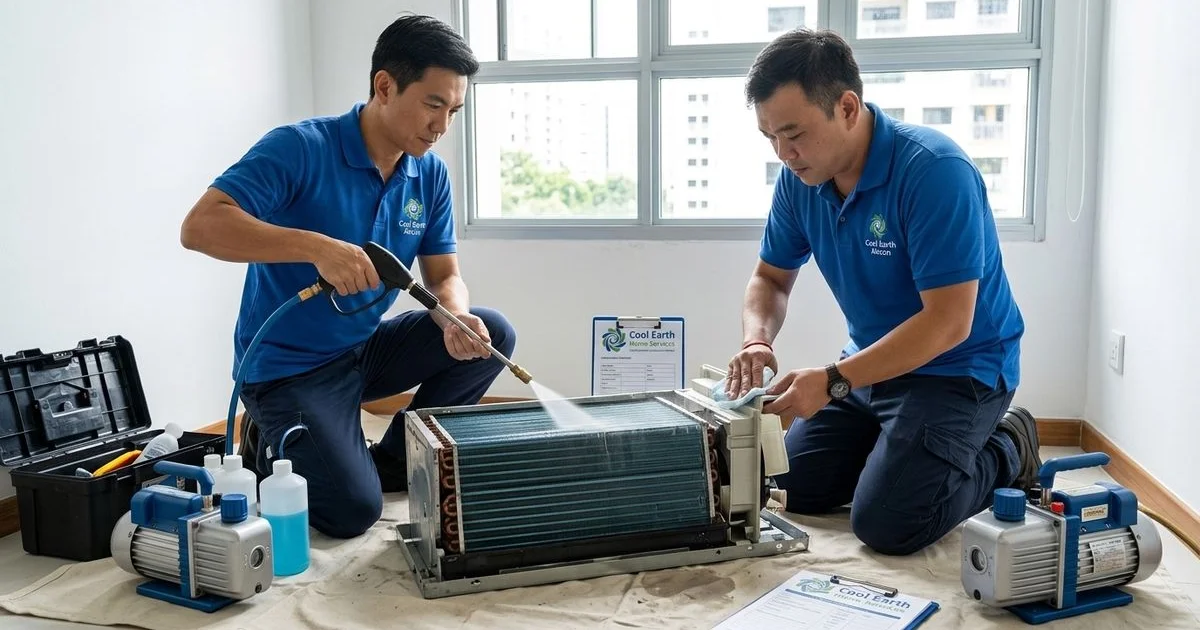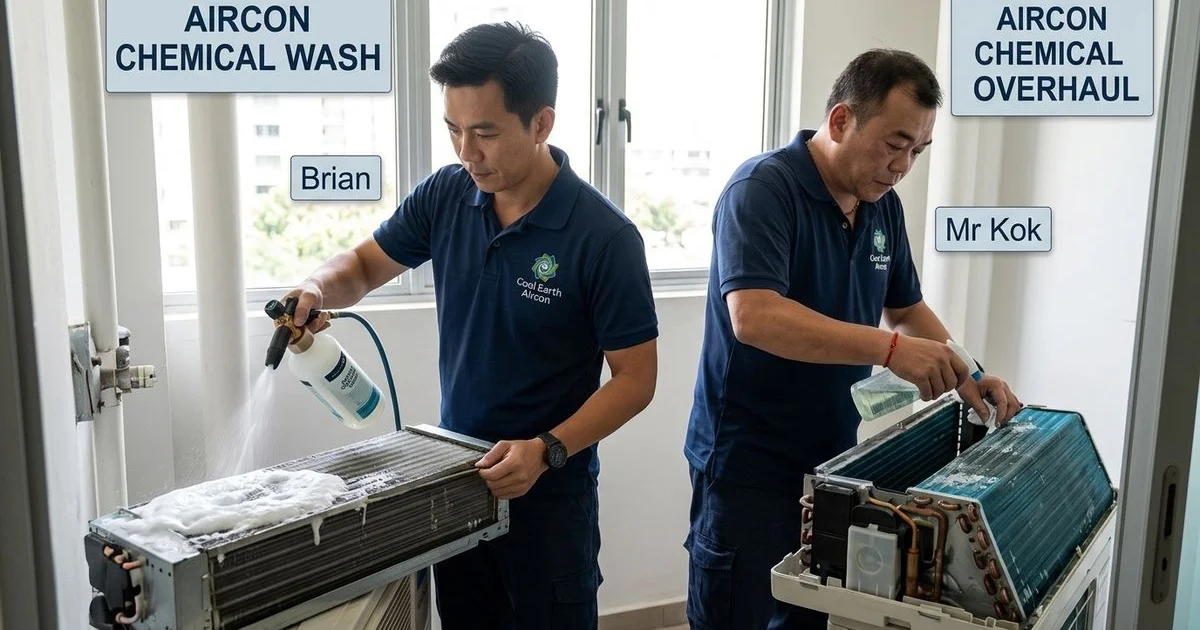
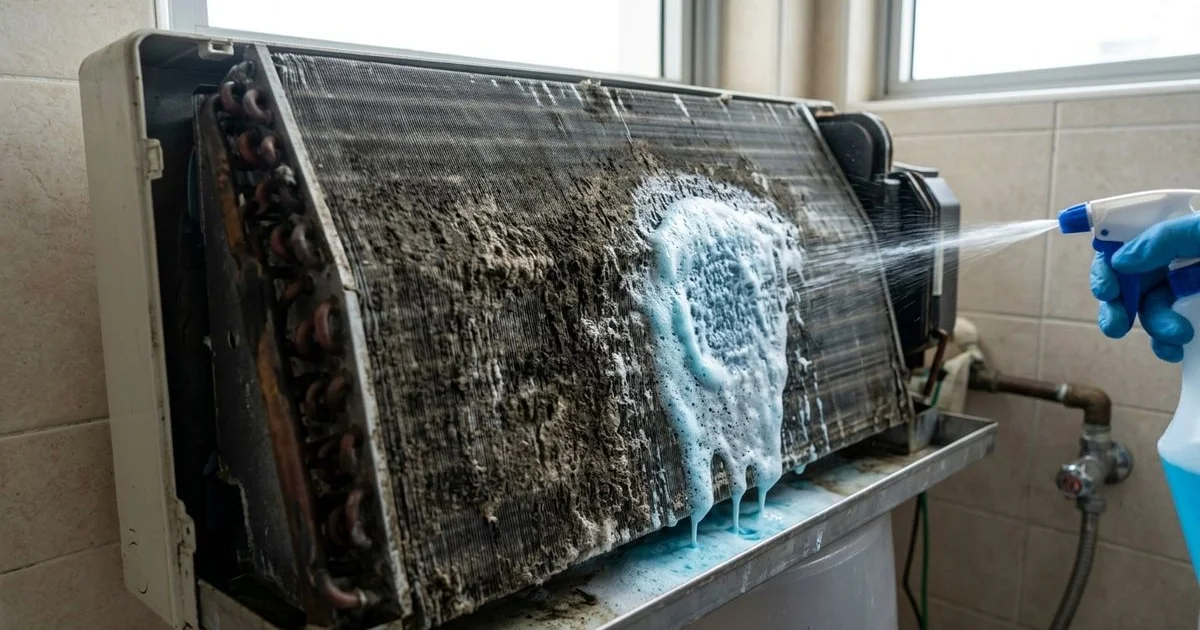
Every week, Singapore homeowners ask us why their cooling systems suddenly stop performing. Recognising the 5 signs your aircon desperately needs a chemical wash can save you hundreds of dollars in repair bills. We founded Cool Earth Aircon Services back in 2007 because Brian saw how improper maintenance ruined perfectly good units. Fast forward to today, and our team hears this same frustration constantly during service calls across HDB estates and commercial offices.
The truth is, Singapore’s 80 to 90 percent tropical humidity creates a harsh environment for cooling equipment. Your aircon rarely needs just a quick wipe down to fix these issues.
It requires targeted maintenance to handle the constant moisture and bacterial load.
Those strange smells, climbing electricity bills, and sudden water leaks act as clear warning signals. They indicate that your system needs a chemical wash to restore its efficiency.
We will cover exactly how to diagnose your system, including:
- Identifying specific mould types hidden inside your unit.
- Calculating the exact electricity cost of a dirty coil.
- Understanding why standard drainage pipes clog so frequently.
Let us explore the clear signs that your unit is overdue for a deep clean and the data behind them.
Sign 1: Musty or Mouldy Smell
This is the most obvious sign and the one that bothers homeowners the most. You switch on your aircon and within minutes, a damp, musty odour fills the room. Some people describe it as a wet sock smell, while others say it smells like old damp towels left in a pile.
What Causes It
Mould and bacteria growing on the evaporator coil, fan blower, and drainage tray produce this damp smell. Singapore experiences year-round humidity levels of 80 to 90 percent. This moisture creates the perfect environment for microbial growth. Your aircon’s internal components remain constantly damp from condensation and stay warm when the unit powers off. These dark enclosures provide the exact conditions mould requires to thrive.
A general service cleans the surface. It cannot reach the mould that penetrates deep into the coil fins.
Our technicians often find that typical wipe-downs leave behind microscopic spores inside the barrel of the fan blower.
The Hidden Health Data
That smell presents a serious health concern for your family. A 2024 Pico X Health Research study in Singapore found that Aspergillus and Penicillium represent the most common mould species thriving in local air conditioning systems. These specific fungi trigger allergic reactions, aggravate asthma, cause persistent coughing, and lead to severe respiratory infections. If anyone in your household exhibits unexplained sneezing, itchy eyes, or a cough that started around the same time as the smell, the aircon likely serves as the main culprit.
The Fix
A proper chemical wash utilises antimicrobial cleaning solutions that kill mould and bacteria on contact. The technician applies the chemical directly to the evaporator coil and fan blower. We leave the solution to penetrate the deep grime before flushing it away entirely. The result delivers a fresh, clean smell from the very first minute you turn on your aircon.
Sign 2: Reduced Cooling Performance
Your aircon runs constantly, but the room does not feel as cold as it used to. You find yourself lowering the temperature setting from 25 to 23 to 21 degrees. Even then, the cold air just does not hit the same way. This gradual decline in cooling serves as a classic indicator that the evaporator coil needs chemical cleaning.
What Causes It
The evaporator coil performs the main cooling function inside your unit. Refrigerant gas, commonly R32 or R410A in Singapore homes, absorbs heat from your room air as it passes over this metal coil. When dirt, dust, and biological growth coat the coil, that grime acts as thick insulation. The air passing over the coil cannot transfer heat efficiently. You get less cooling for the exact same amount of electrical energy.
Think of it like wearing a thick winter jacket inside the house. The jacket insulates your body from the cold air. Similarly, the grime on your coil insulates the room air from the cold refrigerant.
The Numbers and Cooling Loss
A dirty evaporator coil reduces your system’s cooling capacity by 20 to 40 percent. This physical blockage means your 12,000 BTU bedroom aircon must run 20 to 40 percent longer just to reach your desired temperature. This extended run time directly increases your electricity consumption.
Our energy calculations show that over a single month, this inefficiency adds $30 to $60 to the power bill for a typical HDB flat running three units.
If your aircon is not cold and a general service did not solve the issue, a chemical wash serves as the next logical step. It proves much more cost-effective to clear the coil before you investigate expensive possibilities like a gas top-up or compressor repairs.
Sign 3: Water Leaking From the Unit
Water dripping from your indoor unit annoys homeowners and damages your interior fixtures. While installers see several causes for aircon water leaks, a dirty coil and a clogged drainage system rank among the most common culprits. A proper chemical wash completely resolves both of these issues.
How Dirt and Biofilm Cause Leaks
When dirt covers the evaporator coil, water cannot flow smoothly down the coil fins into the drainage tray. Instead, it drips erratically and often misses the tray entirely, falling straight onto your floor. To make matters worse, the organic matter that accumulates on the coil eventually washes into the drainage tray. This organic sludge creates a thick, jelly-like substance called biofilm.
Most HDB aircon installations utilise standard 16mm PVC drainage pipes. These narrow 16mm pipes easily get blocked by this thick biofilm and trapped dust. A clogged pipe forces water to back up in the tray until it eventually overflows onto your walls or furniture.
Why General Servicing Falls Short
General servicing includes using a wet vacuum to clear the drainage pipe. If the source of the blockage remains a heavily contaminated coil continuously shedding debris, a vacuum will never solve the root issue.
Our service teams see vacuumed drainage pipes clog again within weeks if the main coil remains dirty.
A chemical wash actively cleans the actual source of the debris. This deep cleaning process ensures your 16mm drainage pipes stay clear for a much longer period.
Sign 4: Higher Electricity Bills
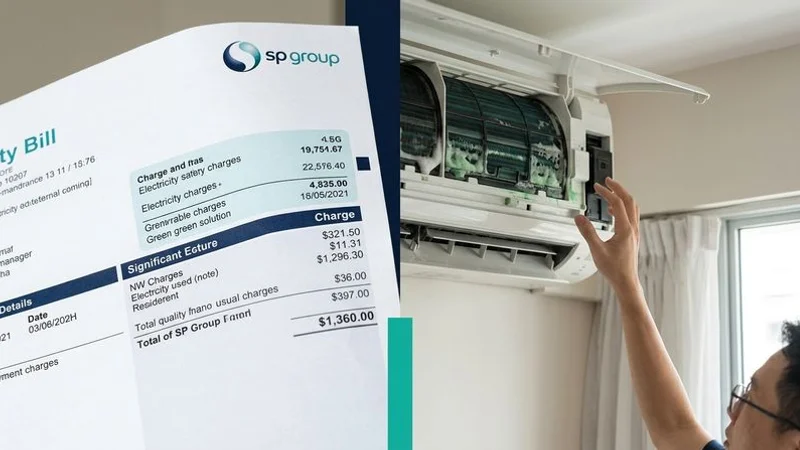
If your SP Group bill keeps climbing and you have not purchased any new appliances, your air conditioning system likely drives the cost. In Singapore, aircon systems account for roughly 30 to 40 percent of a household’s total electricity consumption. When dirty components force your aircon to work harder, that percentage spikes dramatically.
The True Cost of a Dirty Aircon
The SP Group electricity tariff for the first quarter of 2026 sits at 29.11 cents per kWh including GST. At this current rate, running inefficient cooling systems wastes a significant amount of money.
Here is a specific cost comparison for a 3-bedroom HDB flat operating three standard units:
| Aircon Condition | Monthly Electricity Cost (aircon portion) |
|---|---|
| Well-maintained, recently serviced | $80 to $120 |
| Moderately dirty (6 months without chemical wash) | $100 to $150 |
| Very dirty (12+ months without chemical wash) | $130 to $180 |
That gap represents a potential difference of $50 to $60 per month just in wasted energy. Over a single year, you could easily spend $600 to $720 more on electricity than necessary. We price a chemical wash for three units at roughly $200 to $280. This means the maintenance service literally pays for itself within four to six months.
How Chemical Wash Lowers Your Bill
A chemical wash actively restores the evaporator coil’s heat exchange efficiency and the fan blower’s airflow capacity. This restoration allows the compressor to cycle off more frequently instead of running continuously at maximum power. Compressor run time dictates the single biggest factor in your total aircon electricity consumption.
Sign 5: Visible Mould on Vents or Blower
If you open the front panel of your aircon and see black or green spots on the vents, you have visible mould. This clear visual confirmation means the fungal problem has advanced far beyond what a simple general service can handle.
Insider Tip: What to Look For
You can perform a quick inspection yourself using just your smartphone flashlight.
Here is exactly what you should check right now:
- Black spots or streaks on the horizontal vanes, which act as the flaps that direct airflow.
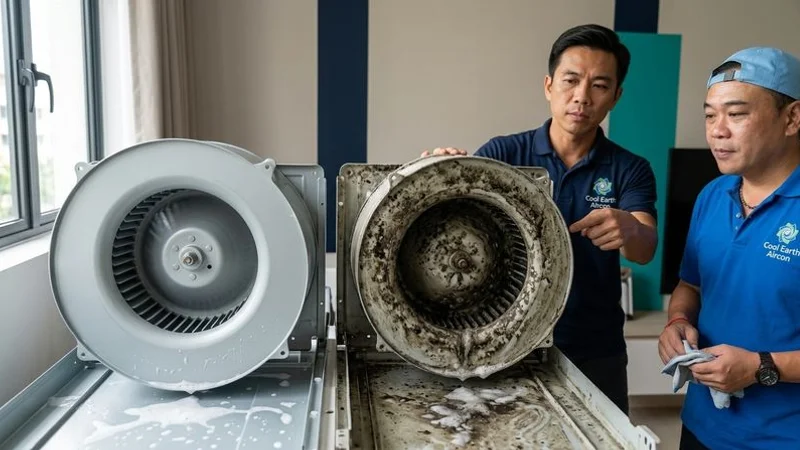
- Green or black coating on the cylindrical fan blower, which technicians often call the squirrel cage.
- Dark discolouration or slime pooling in the bottom drainage tray.
- Dark, dusty residue clinging to the inside of the front plastic panel.
If you shine your phone light up into the unit and the squirrel cage looks like it is covered in dark velvet, your system desperately needs professional attention.
Severe Health Implications
Visible mould proves that the colony is well-established and actively producing millions of spores. Every single time your aircon runs, the fan blows these spores directly into your room and into your lungs. This airborne contamination threatens young children, elderly family members, and anyone dealing with existing respiratory conditions.
Our senior technicians regularly encounter mould growth so heavy that thick black sludge completely coats the entire fan blower. The homeowners in these units had breathed this contaminated air for months without realising the danger. After we completed the chemical wash, they reported that their persistent coughs and allergic symptoms improved significantly within just a few days.
The Fix
For light mould, a standard chemical wash will effectively kill and remove the growth. For heavy mould where the buildup sits thick and widespread, a complete chemical overhaul becomes completely necessary. The overhaul process involves fully dismantling the unit so the technician can individually soak and scrub every single component. Review our comparison of chemical wash vs chemical overhaul for more precise details on these specific methods.
Consequences of Ignoring These Signs
If you recognise any of these warning signs and choose to wait, the system degradation follows a very predictable pattern.
Here is what typically happens to your equipment:
- Month 1 to 2 after noticing signs: Symptoms remain relatively mild. A chemical wash at this point costs $80 to $120 per unit and easily resolves everything.
- Month 3 to 6: Cooling performance drops further and your electricity bills rise noticeably. The musty smell becomes much more pronounced.
- Month 6 to 12: Water leaks become a frequent annoyance. The mould is now deeply embedded in the plastic and metal components. A standard chemical wash alone might not be sufficient. You might need a full chemical overhaul at $130 to $200 per unit.
- Beyond 12 months: Compressor strain from continuous overwork can cause a premature system failure. The 16mm PVC drainage system may suffer from permanent blockages. You might be looking at repair bills costing $300 to $800, or you might even need to replace the entire fan coil unit.
The historical pattern is clear. The earlier you act on these signs, the less money it costs to fix.
How Often Should You Get a Chemical Wash?
For most Singapore households, scheduling a chemical wash every 6 to 12 months strikes the right balance between maintenance costs and long-term unit health.
Here is a specific recommendation based on our technical experience:
| Situation | Chemical Wash Frequency |
|---|---|
| Regular general servicing (every 3 months) | Once a year |
| Moderate servicing (every 4 to 6 months) | Every 6 to 8 months |
| Infrequent servicing | Every 6 months minimum |
| Pets in the home | Every 6 months |
| Smoker in the home | Every 6 months |
| Heavy usage (12+ hours a day) | Every 6 months |
Combine regular general servicing with periodic chemical washes to protect your investment. Your aircon will reward you with consistent cooling, clean indoor air, and perfectly reasonable electricity bills for many years.
We suggest checking our servicing price page for current chemical wash rates. You can also learn more about our full range of technical services, including gas top-up and new system installation.
Do you recognise any of these 5 signs your aircon desperately needs a chemical wash in your own home? Do not wait for the performance issues to get worse or for your bills to spike.
Contact our support team via WhatsApp at wa.me/6594273833 to secure your booking.
We will schedule your chemical wash at a time that perfectly suits your busy calendar.

Brian founded Cool Earth Aircon in 2007. With 18 years of hands-on experience servicing aircon systems across Singapore, he leads a team that has maintained over 4,560 units.
Licensed Aircon Technician | 18 Years Experience | Three Best Rated (Tampines)