You know how quickly a cooling system starts sputtering when the dry season hits, usually right when you need it most. We see this exact scenario play out every single week across the island. If you are searching for an exact answer to “How Often Should You Service Your Aircon in Singapore? (2026 Guide)”, this complete breakdown has you covered.
That critical breaking point for cooling systems usually hits right around the three-month mark, separating standard, inefficient units from the truly reliable ones.
Since Brian founded Cool Earth Aircon Services in 2007, our team has been mapping out the exact maintenance frequency required to prevent costly breakdowns. Let us look at the data, what it is actually telling us about component wear, and explore a few practical ways to respond.
How Often Should You Service Your Aircon in Singapore? (2026 Guide)
For most households, the ideal servicing frequency is once every 3 to 4 months. That works out to roughly three or four visits per year. We base this specific timeline on how quickly tropical humidity degrades internal components.
The National Environment Agency (NEA) recommends setting your thermostat to 25 degrees Celsius for optimal efficiency. A standard 12,000 BTU unit still consumes roughly 7 kilowatts of electricity per hour even at this sensible setting. Our technicians find that running a system this hard inevitably accelerates dust and moisture buildup.
Recent local health studies show that 60 percent of mould issues in Singapore homes actually originate from condensation trapped inside aircon trunking. You cannot afford to let that moisture sit unaddressed.
Here is a quick guide based on usage patterns:
| Usage Level | Frequency | Typical Household |
|---|---|---|
| Light (4-6 hours/day) | Every 4 months | Single person, working from office |
| Moderate (8-10 hours/day) | Every 3 months | Family of 3-4, standard usage |
| Heavy (12+ hours/day) | Every 2-3 months | Large family, pets, WFH |
| Commercial | Monthly | Offices, retail, F&B |
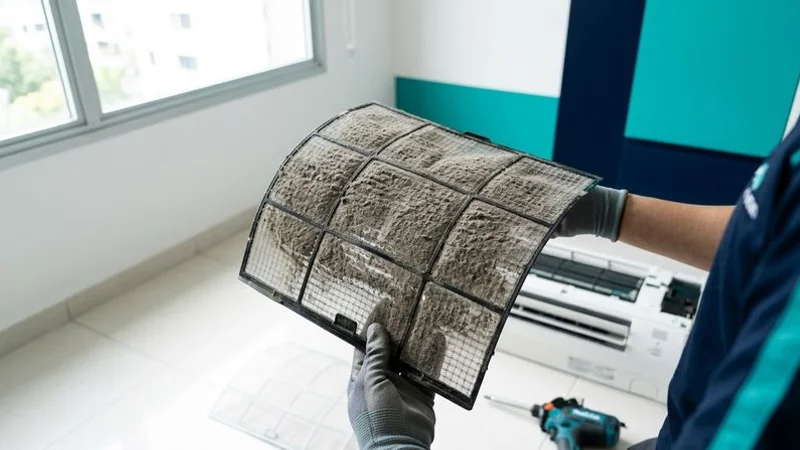
If you have pets at home, you must lean towards the shorter end of the range. Pet dander clogs filters rapidly, reducing airflow by up to 15 percent within a matter of weeks. Our team always checks the blower wheel first in homes with dogs or cats.
Why Singapore’s Climate Demands More Frequent Servicing
1. High Humidity Breeds Mould
Singapore’s average humidity sits between 70 and 90 percent throughout the year. Your evaporator coil constantly condenses moisture from this thick air, creating a permanently damp environment inside the casing. We consistently find Aspergillus mould thriving in these exact conditions.
This specific fungus is notorious for causing allergic reactions and respiratory irritation. Without regular cleaning, the blower fan circulates these active spores back into your bedroom every single night. Our chemical cleaning process specifically targets and neutralizes these biological hazards.
2. Dust and Pollution
Between construction activity, vehicle emissions, and periodic regional haze, the local air carries a heavy particulate load. Your filter captures these tiny particles, but it quickly reaches maximum capacity. We see saturated filters force the compressor to work significantly harder, which drives up your monthly utility bill.
3. Year-Round Operation
Unlike countries with distinct seasons, local cooling systems run all year without a winter break. This continuous operation means wear and tear accumulates rapidly on moving parts. Our maintenance records show that neglected fan bearings and capacitors fail twice as fast under these relentless conditions.
The compressor itself accounts for 40 to 60 percent of the total system replacement cost. You can extend its lifespan from a dismal 5 years to a healthy 15 years simply by keeping the heat exchangers clean. We prioritize protecting this vital, expensive component during every visit.
What Happens When You Skip Servicing
We have seen this progression hundreds of times. A homeowner skips one service, then another, and soon they are calling us because the aircon is not cold or there is water leaking from the unit. We map out the typical timeline of neglect below so you know exactly what to watch for.
The Timeline of Neglect
- Month 1 to 3: The unit performs normally, but filters quietly start accumulating a thick layer of dust.
- Month 4 to 6: Airflow drops noticeably, prompting you to lower the temperature setting to compensate.
- Month 6 to 9: The evaporator coil becomes coated in sticky grime, and the drainage pipe starts choking on debris.
- Month 9 to 12: Water starts dripping inside the room, and the cooling performance plummets.
- Beyond 12 months: You face severe compressor strain, refrigerant leaks, or dangerous electrical faults.
The financial penalty for waiting is steep, especially with the 2026 carbon tax doubling to $45 per ton of emissions. That policy change directly inflates electricity tariffs. We calculate that a dirty, inefficient system now adds an extra $30 to $45 to your monthly SP Group bill.
Annual Contracts vs Ad-Hoc Servicing
When planning your maintenance, you generally choose between signing an annual contract or calling for help only when something breaks. We strongly advocate for the proactive approach.
Annual Service Contract
An annual agreement typically covers 3 to 4 scheduled visits per year at a locked-in rate. Our own annual contract at Cool Earth Aircon starts from $200 for a single unit, breaking down to just $50 to $67 per visit.
Benefits of a proactive contract:
- Lower per-visit cost compared to single bookings
- Priority scheduling during the peak hot months of March through May
- Consistent tracking of component wear and tear
- Basic troubleshooting included at no extra charge
Ad-Hoc Servicing
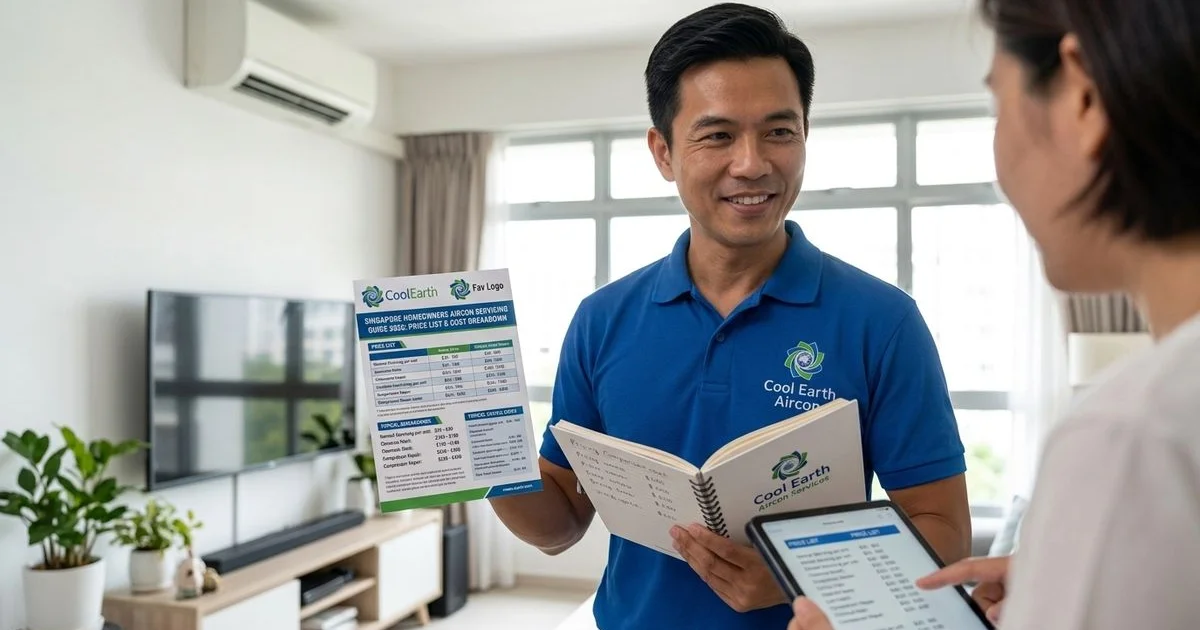
Booking individual appointments means you only call when you realize there is a problem. The standard per-visit cost is noticeably higher, usually ranging from $50 to $110 for general maintenance. You can review our comprehensive servicing price list for the exact 2026 rates.
Most people simply forget to book until it is too late. By the time you finally make the call, you often require a deep chemical wash instead of a basic wipe-down. We see this exact delay cost homeowners an average of $80 to $120 per unit for the intensive chemical treatment alone.
What Does a Standard Aircon Service Include?
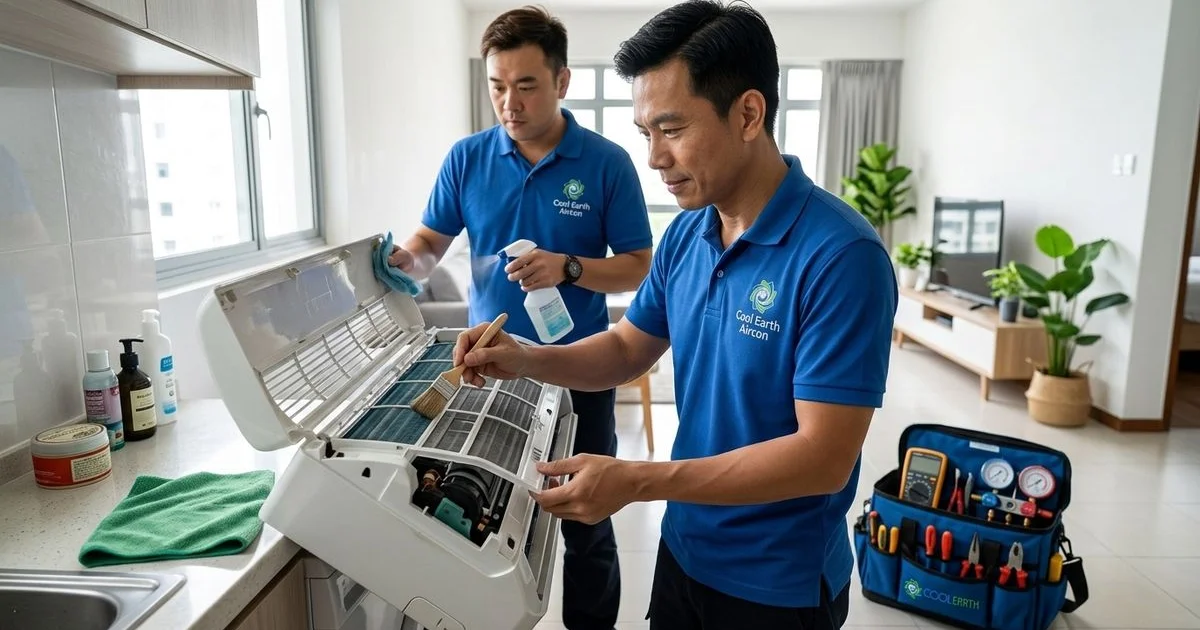
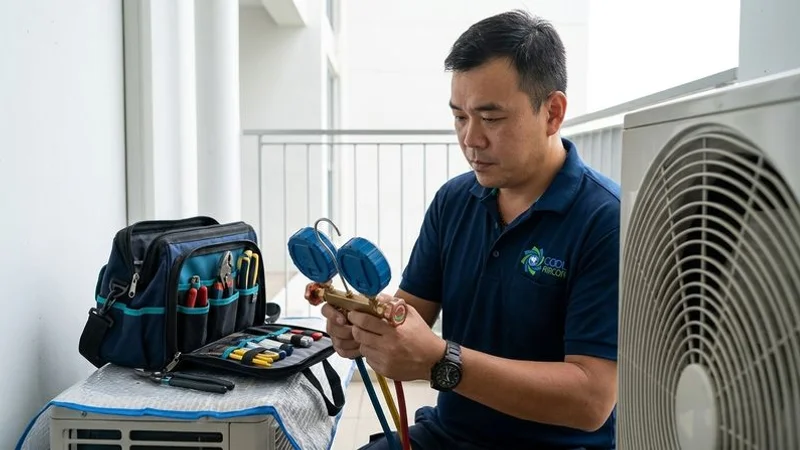
A professional general service must cover several critical checkpoints to be effective. We refuse to cut corners, as a rushed 5-minute job simply cannot clear deep-seated blockages.
The essential maintenance checklist:
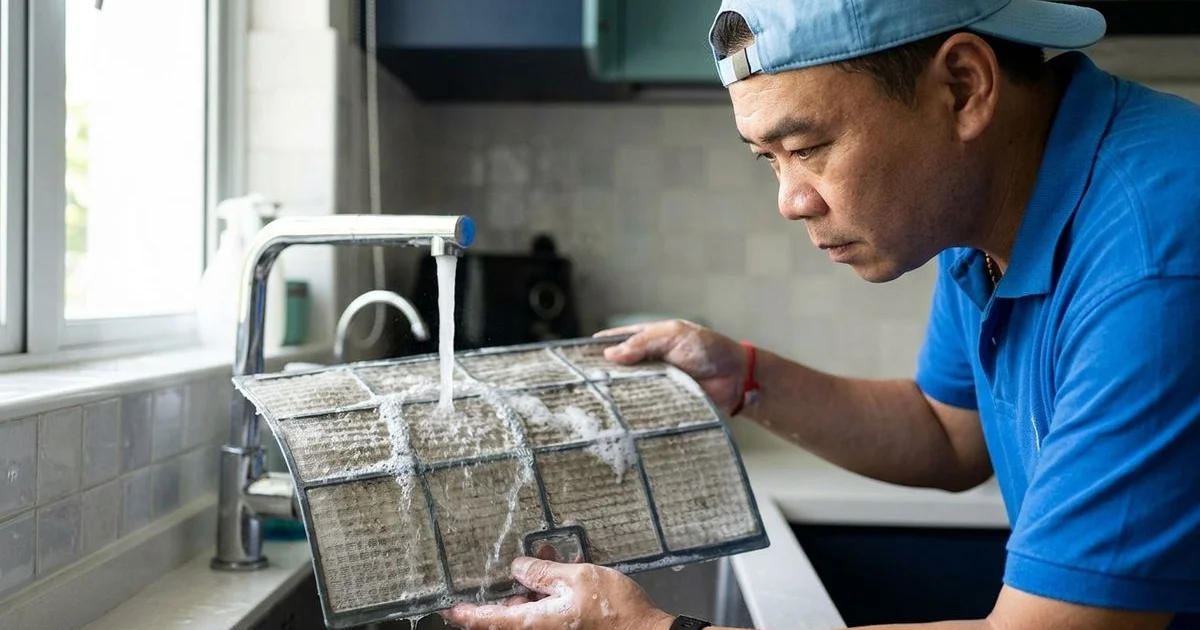
- Filter cleaning: Removes allergens and restores basic airflow.
- Evaporator coil washing: Clears surface grime to restore vital heat transfer efficiency.
- Drainage pipe flushing: Forces out the gelatinous algae that causes indoor water leaks.
- Fan blower brushing: Dislodges heavy dust from the blades to stop annoying vibrations.
- General inspection: Tests thermostat accuracy and verifies electrical connections.
- Condenser check: Examines the outdoor unit for dangerous obstructions and debris.
A proper session takes roughly 20 to 30 minutes per indoor unit. Our technicians use this time to carefully check for early warning signs of component failure. You should always ask questions if a contractor tries to rush through these steps.
How to Know If You Need More Than General Servicing
Sometimes routine care is not enough to fix a heavily degraded system. You need to recognize the specific warning signs that indicate a more serious underlying issue.
Watch for these critical red flags:
- Persistent bad smell: You almost certainly need a thorough chemical wash to eradicate deep-seated Aspergillus mould.
- Room stays warm: This points directly to a gas top-up requirement or a failing compressor.
- Indoor water dripping: The drainage pan is overflowing, requiring an immediate high-pressure flush.
- Strange buzzing sounds: The fan motor bearings are grinding, or loose parts need tightening.
We detailed the exact causes of these frustrating mechanical sounds in our recent guide on noisy aircon units.
Cost Savings From Regular Maintenance
Let us break down the exact numbers to prove why proactive care is a highly profitable investment. We use the current 2026 electricity tariff of roughly 32 cents per kilowatt-hour for these calculations.
Scenario A: Proactive Maintenance (Every 3 months)
- 4 visits per year at $50 each = $200 annually
- Electricity savings from peak efficiency = $120 to $180 annually
- Major repair probability: Extremely low
- Expected unit lifespan: 10 to 15 years
Scenario B: Total Neglect
- $0 spent on routine care
- Wasted electricity costs = $120 to $240 extra annually
- Mandatory chemical overhaul within 12 months = $140 to $170
- High risk of major breakdown ($200 to $500) within 3 years
- Expected unit lifespan: 5 to 8 years
Over a standard 10-year period, the homeowner who maintains their system saves an estimated $2,000 to $4,000. We have not even factored in the massive expense of buying a brand-new system prematurely, which easily costs $1,200 to $3,000.
Setting Up Your Servicing Schedule
The most reliable way to protect your equipment is to set a recurring digital reminder. We suggest picking a quarterly pattern, such as January, April, July, and October, to ensure year-round coverage.
Another option is to outsource the mental load entirely by signing an annual agreement. Our dispatch team will proactively text you when your next session is due. You will never miss a vital cleaning window again.
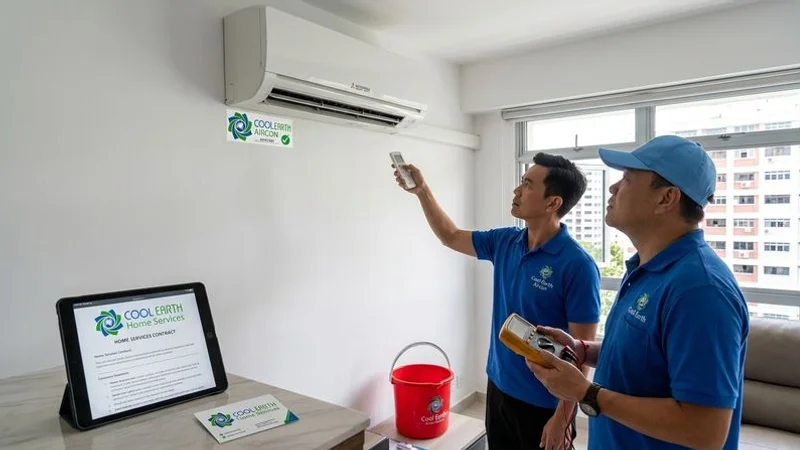
At Cool Earth Aircon, we service all major brands, including Daikin, Mitsubishi, Panasonic, LG, and Fujitsu. Fully equipped vans are ready to deploy whether you live in an HDB flat, a private condo, or a sprawling landed property.
Final Thoughts
Do not wait until your aircon breaks down to give it attention. In Singapore’s climate, regular servicing every 3 to 4 months is not optional, it is essential.
Understanding How Often Should You Service Your Aircon in Singapore? (2026 Guide) is the key to keeping your air clean and your electricity bill manageable. It helps your unit run for years longer than it otherwise would.
If it has been more than 4 months since your last service, now is a good time to book one. The longer you wait, the more it will cost you down the line.
Ready to book your aircon servicing? WhatsApp us at wa.me/6594273833 for a quick quote. We serve all areas across Singapore with transparent pricing and no hidden fees.

Brian founded Cool Earth Aircon in 2007. With 18 years of hands-on experience servicing aircon systems across Singapore, he leads a team that has maintained over 4,560 units.
Licensed Aircon Technician | 18 Years Experience | Three Best Rated (Tampines)