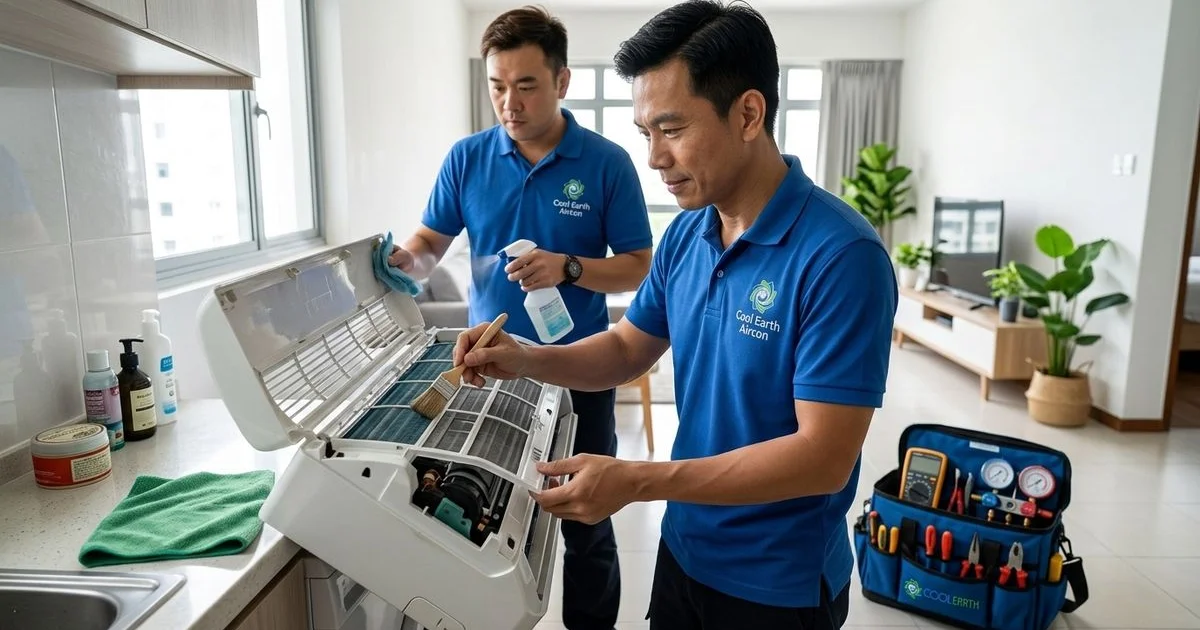
We see the same frustrated homeowners every week.
Since Brian founded Cool Earth Aircon Services in 2007, our team has learned that most sudden breakdowns are entirely preventable.
Our experience shows that routine upkeep bridges the gap between professional aircon servicing visits.
With the Q1 2026 SP Group electricity tariff sitting at 29.11 cents per kWh, an inefficient system drains your wallet faster than ever.
We are going to break down the 7 DIY aircon maintenance tips every homeowner should know to keep costs low.
Let us explore the data behind these simple tweaks and exactly how they protect your equipment.
1. Clean Your Air Filters Every 2 to 4 Weeks
We always check the filters first during any service call.
A clogged filter forces the compressor to work much harder to push cool air into the room.
Our technicians regularly see dirty filters increase electricity consumption by 5 to 15 percent.
Dust eventually bypasses a blocked mesh and coats the evaporator coil, which then requires a professional chemical wash to clean.
How to Clean Your Filters
- Switch off the power: Open the front panel by gently lifting it up.
- Slide out the panels: Most basic units use lightweight mesh screens.
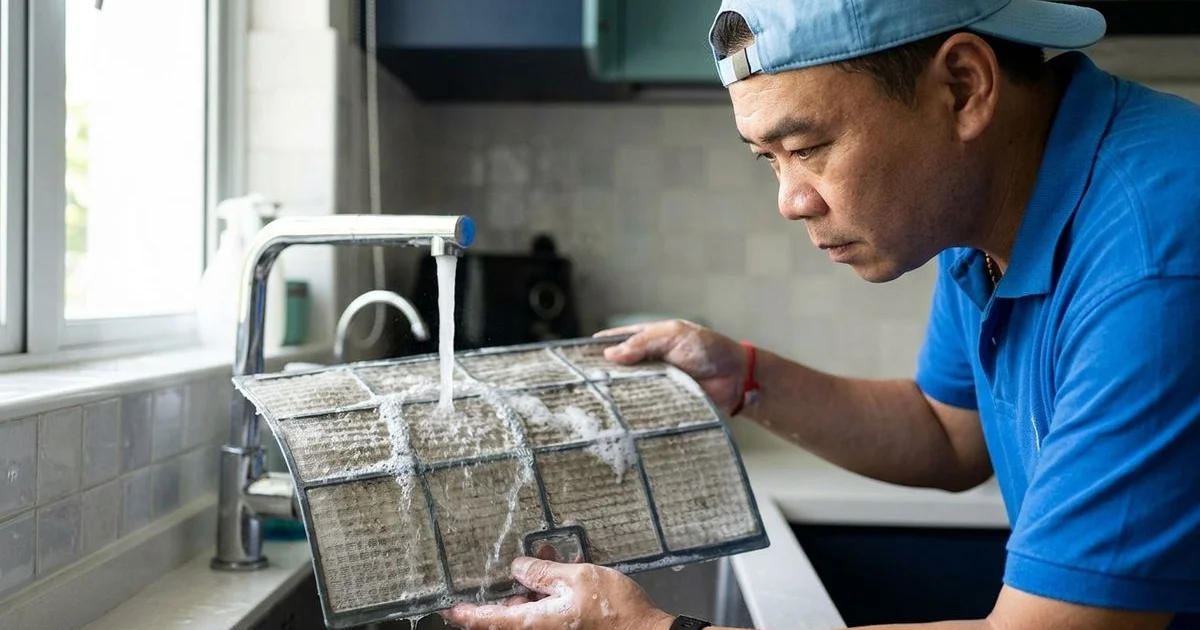
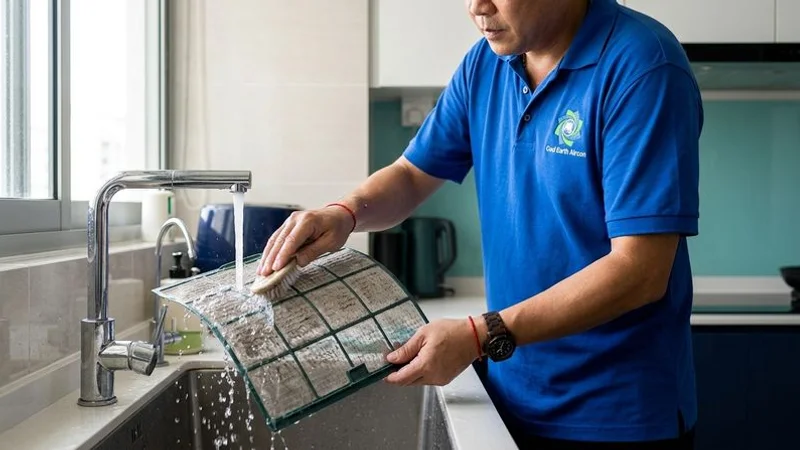
- Rinse under running water: Use lukewarm water and gently rub the surface to remove dust.
- Treat stubborn dirt: Soak the material in mild soapy water for 10 minutes before rinsing.
- Dry completely: Shake off excess moisture and let the plastic dry before reinserting.
- Avoid hot water: High temperatures easily warp the delicate plastic frames.
We highly recommend adjusting your cleaning schedule based on the type of filter you use.
Standard mesh screens need a wash every two weeks, especially if you have pets.
Our team suggests replacing specialized Daikin PM2.5 filters every six months, as they trap microscopic particles and cannot be washed.
If your system uses a Titanium Apatite deodorising filter, regular washing extends its lifespan to about three years.
2. Keep the Area Around Your Outdoor Condenser Clear
We frequently find outdoor condenser units suffocating behind boxes and laundry racks.
The condenser releases heat from your home to the outside air.
Our inspections show that blocked airflow drastically reduces cooling capacity.
The Housing & Development Board (HDB) explicitly states that the aircon ledge is a designated spot for the compressor alone.
Essential Clearance Rules
- Remove all storage: Do not place boxes, pots, or laundry racks near the unit.
- Maintain a 30cm gap: Ensure at least 30cm of empty space on all sides for proper ventilation.
- Clear away debris: Sweep away leaves and cobwebs from the front grille.
- Check for corrosion: Look closely at the mounting brackets to spot early signs of rust.
- Leave fins alone: Do not attempt to straighten bent aluminium fins without a specialised fin comb.
We urge residents to treat the ledge as a functional utility space rather than a balcony extension.
Blocking this area forces the system to run hotter and creates a serious fire hazard.
Our technicians also notice that placing objects on the condenser casing causes loud vibrations.
Unrestricted airflow ensures the compressor operates efficiently and quietly.
3. Check Your Drainage Pipe Regularly
We get hundreds of emergency calls every year for water dripping down indoor walls.
This messy problem usually starts with a blocked condensate drainage pipe.
Our climate creates the perfect storm for this issue.
Singapore’s constant 80 percent humidity causes massive amounts of condensation, which eventually breeds a thick algae buildup known as aircon jelly.
Preventing Aircon Jelly Buildup
- Inspect the drain outlet: Look at the exterior pipe to confirm water drips out steadily while the system runs.
- Check for slime: Open the front panel and look for a green or black jelly-like substance in the drainage tray.
- Test the flow: Pour a small cup of water into the tray to see if it drains immediately.
- Apply a vinegar flush: Pour a mixture of one part white vinegar to three parts warm water down the line.
We find that a quarterly vinegar flush dissolves early algae formation effectively.
When the jelly hardens and completely blocks the pipe, water backs up and starts leaking from your indoor unit.
Our plumbers use specialised wet vacuums to clear severe blockages.
If the vinegar trick fails to restore a smooth flow, you need professional intervention.
4. Set Your Temperature to 24 to 25 Degrees Celsius
We often see remotes permanently set to 18 degrees.
Setting the thermostat to an extremely low number does not cool the room any faster.
Our tests confirm that the system simply pumps out cold air at the exact same rate regardless of the target temperature.
The National Environment Agency (NEA) strongly recommends keeping your setting at 25 degrees Celsius for optimal efficiency.
The Cost of Overcooling
| Thermostat Setting | Compressor Workload | Electricity Impact |
|---|---|---|
| 24 to 25°C | Normal cycling | Baseline energy usage |
| 22 to 23°C | Heavy continuous running | Adds roughly 10 to 15% to bill |
| 18 to 20°C | Maximum sustained strain | Adds 20 to 30% to bill |
We advise pairing a sensible temperature setting with good air circulation.
Using a ceiling fan allows you to set the thermostat two degrees higher while feeling equally comfortable.
Our clients who adopt this habit often save up to $40 a month.
Every single degree below 24 degrees adds roughly 5 to 10 percent to your cooling costs.
5. Use Timer and Sleep Modes
We highly encourage taking advantage of the smart features built into modern remotes.
These buttons do far more than just turn the machine off.
Our team knows that using energy-saving modes correctly drastically cuts down wear and tear.
Maximising Smart Features
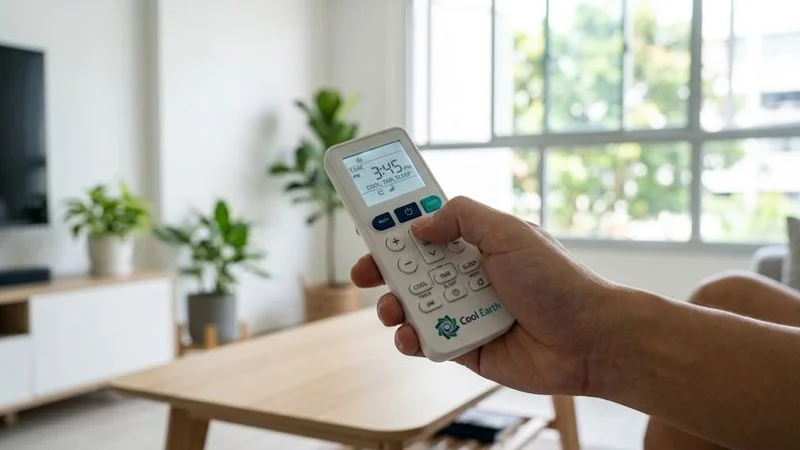
- Master the Sleep Timer: Set the unit to switch off after three hours, as your body naturally cools down during deep sleep.
- Activate Daikin Night Set Mode: This specific feature prevents midnight freezing by automatically raising the room temperature by 0.5 degrees after 60 minutes.
- Use Mitsubishi Econo Cool: This mode runs the system at 70 percent capacity, raises the target temperature by 2 degrees, and uses a vertical swing airflow to keep you comfortable.
- Switch to Dry Mode: On rainy days, use this setting to remove sticky humidity from the air without overworking the compressor.
We consider Dry mode the secret weapon against tropical humidity.
Removing moisture makes the room feel drastically cooler than the actual temperature reading.
Our smart home integration setups always prioritise these automated schedules.
A few button presses transform an energy-hungry machine into a highly efficient cooling system.
6. Seal Gaps Around Your Aircon and Room
We constantly remind clients that cooling a leaky room is like pouring water into a bucket with a hole.
Warm air seeping in forces the compressor to run continuously to maintain the target temperature.
Our thermal imaging tools regularly expose massive energy leaks around windows and piping holes.
Areas to Inspect and Seal
- The copper piping hole: Use specialised Aircon Wall Hole Sealing Putty to plug the gap where pipes exit the wall.
- Window edges: Apply 3M Transparent Silicone Sealing Strips along glass doors and sliding windows to block warm drafts.
- Underneath doors: Slide a heavy draft stopper under the bedroom door to keep the cold air contained.
- Direct sunlight: Draw thick curtains between 12pm and 4pm to block solar heat gain in west-facing rooms.
We guarantee that fixing these minor leaks yields immediate results.
A properly sealed room drops the cooling workload by up to 20 percent.
Our simple putty fix for the piping hole stops both hot air and unwanted pests from entering.
Tightening up your room boundaries provides the fastest return on investment for any DIY task.
7. Know When to Call a Professional
We always respect a homeowner who takes charge of basic upkeep.
Certain components present serious safety risks and require licensed expertise.
Our technicians undergo rigorous training to handle high-voltage parts and pressurised chemicals.
Warning Signs You Need an Expert
- Warm air blowing: If the unit fails to cool despite clean filters, you likely need a professional refrigerant gas top-up.
- Persistent dripping: Water pooling after a vinegar flush means the drain pan or back tray is severely clogged.
- Mechanical grinding: Rattling or hissing noises indicate failing motors, which you can diagnose further using our noisy aircon guide.
- Burning plastic smells: Switch off the mains power immediately, as this points to a melted wire or failing capacitor.
- Flashing error lights: These specific blinking patterns require a proprietary diagnostic tool to decode.
We strictly advise against opening the sealed refrigerant system.
Modern R32 refrigerant gas operates under high pressure and is mildly flammable, meaning mishandling it violates safety regulations.
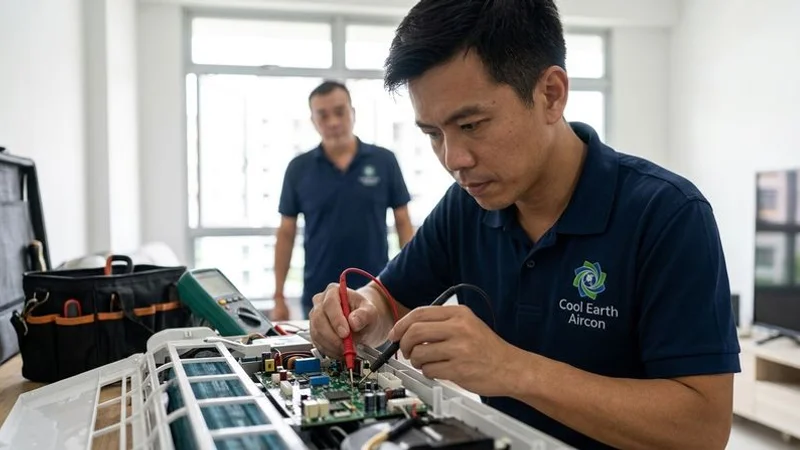
Our team also warns against tampering with the Printed Circuit Boards (PCBs).
Touching these sensitive electronic components without proper grounding easily destroys the entire control system.
Putting It All Together
We created this schedule to keep your system running smoothly all year long.
Consistent care prevents minor dust buildup from escalating into a costly compressor failure.
Our service records clearly show that well-maintained units last up to 15 years.
Neglected systems rarely survive past year eight in this demanding tropical climate.
Your Annual Maintenance Calendar
| Frequency | Maintenance Task |
|---|---|
| Every 2 weeks | Wash standard mesh air filters |
| Monthly | Clear debris from outdoor condenser |
| Monthly | Flush drainage pipe with vinegar solution |
| Daily | Utilise 25°C setting and sleep timers |
| Seasonally | Inspect putty seals and window strips |
| Every 4 months | Schedule standard professional servicing |
| Every 12 months | Book a deep chemical overhaul |
We want your professional visits to be quick, predictable, and cheap.
Mastering these 7 DIY aircon maintenance tips every homeowner should know eliminates nasty surprises during routine checks.
Our complete servicing price guide details exactly what to expect when you book a session.
A proactive approach always beats a reactive emergency repair.
Need a hand with a stubborn leak or a flashing error light?
Reach out to our team directly via WhatsApp at wa.me/6594273833.
We are always ready to troubleshoot your system and get your room cold again.

Brian founded Cool Earth Aircon in 2007. With 18 years of hands-on experience servicing aircon systems across Singapore, he leads a team that has maintained over 4,560 units.
Licensed Aircon Technician | 18 Years Experience | Three Best Rated (Tampines)